
Lessons from Veralto's Leadership Journey
Quick answer: Experiential learning programs drive growth when they combine self-awareness tools, a realistic business simulation, and structural accountability (manager involvement, budget ownership, advance nomination). Veralto's Maximizing Leadership Performance (MLP) program, built with CentrX, applies this model over a journey and reports strong participant scores, faster enterprise-level thinking, and lasting cross-functional networks.
When Veralto spun off from Danaher in 2023, the newly independent company faced a challenge familiar to any fast-growing enterprise: how do you build a pipeline of senior leaders ready to operate at scale, while also shaping a distinct culture from the ground up?
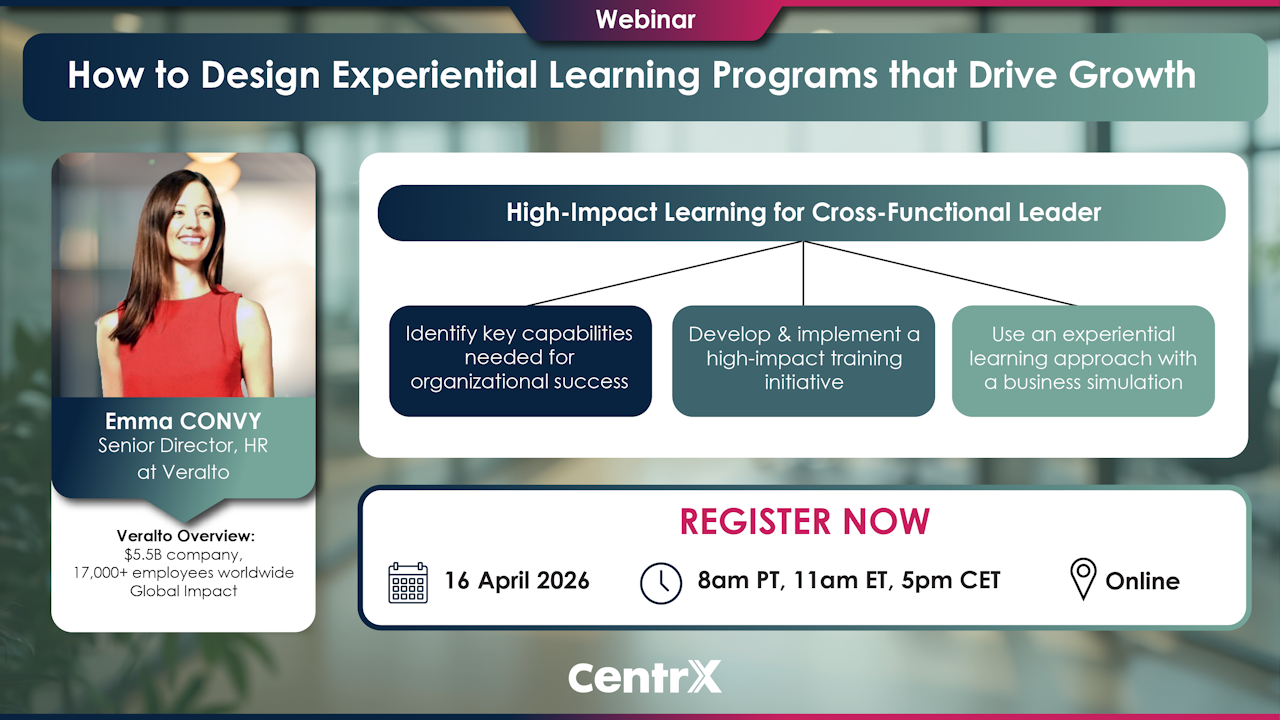
In a CentrX webinar, Emma Convy, Senior Director of HR at Veralto, joined CentrX's Sebastien Lamiaux and Philippe Latapie for a fireside chat on exactly that question. This article summarizes what she shared about Veralto's flagship leadership program and why a business simulation became one of its most valuable components.
What is experiential learning?
Experiential learning is leadership development through direct practice rather than passive instruction. Instead of teaching frameworks in a classroom, participants make real decisions in a realistic, simulated environment, then reflect on the outcomes with facilitators and peers. CentrX defines it as "learning by doing" — compressing years of business experience into days or hours so leaders can build judgment they'd otherwise only gain on the job.
What is Veralto and why does its leadership approach matter?
Veralto is a public company, spun out of Danaher in 2023, operating in two areas: water quality and product quality. On the water side, it helps cities, labs, and industrial companies test and manage water systems. On the product side, it works with manufacturers to keep everyday goods, like food and beverages, safe and consistent. Because both areas are mission-critical and highly regulated, Veralto's leaders need to make sound decisions under real pressure, which is part of why the company invests heavily in experiential leadership training.
What is Veralto's MLP program?
MLP (Maximizing Leadership Performance) is Veralto's enterprise-wide, nomination-only leadership development program for emerging senior leaders. Key facts:
|
Detail |
Description |
|
Format |
The program combines several half-day sessions delivered across four non-consecutive weeks, allowing participants to apply their learning over a period of approximately three months. |
|
Audience |
People leaders preparing for broader, more complex enterprise roles |
|
Core components |
Self-study, instructor-led virtual modules, a business simulation, in-person sessions, manager touchpoints |
|
Delivery partner for simulation |
CentrX |
MLP exists because functional or technical excellence, the skills that got someone into their current role, usually isn't enough for the next one. The program is designed to build enterprise-level thinking, a shared leadership language, and stronger execution of strategy across business, function, and geography lines.
What are MLP's four core development areas?
-
Leading with integrity
-
Strategic and systems thinking
-
Influence and enterprise leadership
-
Winning as a team
These themes recur across every part of the program, from self-study to the simulation to peer collaboration, so participants encounter them repeatedly rather than once.
What role does the business simulation play in MLP?
The business simulation is the applied centerpiece of MLP, and Veralto's team describes it as one of the program's most impactful elements. Teams of five or six participants play the C-suite of a fictional company, making strategic and operational decisions, "where to play" and "how to win" choices, under time pressure and incomplete information, across several simulation rounds.
How the simulation is structured:
-
A short synchronous session opens each round, where a facilitator introduces the scenario.
-
Teams then spend several hours making decisions collaboratively, with a facilitator available to guide and question them.
-
Each round ends with a post-action debrief, where the team reflects on how they worked together and which leadership behaviors showed up.
-
The format repeats across consecutive half-days, culminating in a competitive results session.
Why does simulation-based learning work for leadership development?
Three reasons came up repeatedly in the webinar:
-
It mirrors real complexity. Senior leadership success depends less on knowing frameworks and more on making decisions under pressure with incomplete information and competing priorities, exactly what the simulation recreates.
-
It's a safe environment for failure. Leaders can experiment and make mistakes without the real organizational cost, then see the downstream, cross-functional consequences of their choices play out.
-
It accelerates learning through action. Participants learn faster when they have to act, decide, and reflect in the moment, rather than just observe or discuss theory abstractly.
What impact has MLP had on Veralto's leaders?
Based on Veralto's internal post-program feedback, MLP participants consistently report:
-
Enterprise-level thinking: leaders shift from optimizing their own function to weighing trade-offs across the whole organization.
-
Greater self-awareness: tools like the Hogan Assessment, combined with peer feedback and the experiential components, produce a measurable impact on how leaders understand their own patterns.
-
Immediate on-the-job application: particularly in influencing, decision-making, and navigating complexity.
-
Lasting cross-functional networks: relationships formed across businesses, functions, and geographies tend to continue well after the program ends.
Participants consistently rate the program highly on both overall value and likelihood to recommend it to peers.
How does Veralto handle the time commitment challenge?
Asking senior leaders to commit several half-days across four weeks is, in Emma Convy's words, "a struggle." Veralto addresses this in a few concrete ways:
-
Nominations are collected roughly six months in advance.
-
Multiple cohorts run each year, so participants with scheduling conflicts can move to a different session.
-
Manager and leadership-chain involvement starts at the top: the business president, the leadership team, and the direct manager are all part of the communication plan before a participant begins.
-
Budget ownership: each participant's business unit pays for their seat, reinforcing that attendance is a real commitment rather than optional.
Is Veralto using AI in its leadership simulation?
Not formally yet, but it's an active area of exploration. Emma Convy noted that participants have already started experimenting with tools like Copilot during the simulation, for example, to analyze Hogan Assessment results. Veralto is evaluating how to intentionally incorporate AI as a supplement to the program, while being careful not to let it bypass the skills the simulation is designed to build.
Key takeaway
Veralto's experience with MLP shows that leaders build enterprise-level judgment by practicing it, not just hearing about it. A well-designed business simulation creates a safe space to make consequential decisions, see the ripple effects, and reflect with peers, compressing years of leadership experience into a few focused days. Pairing that with genuine organizational accountability, from nomination through manager involvement, is what turns a training event into lasting behavior change.
FAQ
What is a leadership business simulation?
A leadership business simulation is a structured exercise where participants take on executive roles in a fictional company and make strategic and operational decisions across multiple rounds, receiving feedback on the outcomes. It's used to build judgment and systems thinking in a risk-free setting.
How long is Veralto's MLP program?
MLP runs for four weeks of programming spread across approximately three months, combining self-study, virtual instructor-led sessions, a multi-day business simulation, in-person sessions, and follow-up manager touchpoints.
Who is MLP designed for?
MLP is designed for people leaders at Veralto who are preparing for broader, more complex roles across the enterprise. It's a nomination-only program.
Why do companies use experiential learning instead of traditional training?
Experiential learning produces faster, deeper skill retention because participants act, decide, and reflect on real consequences rather than passively consuming content. Organizations like Veralto report it as one of the highest-impact elements of their leadership programs.
Who delivers Veralto's leadership simulation?
CentrX, a leadership development firm specializing in experiential learning and business simulations, designs and facilitates the simulation used in Veralto's MLP program.
Want to learn how a business simulation could fit into your organization's leadership development strategy?


-1.png "centrx logo")
